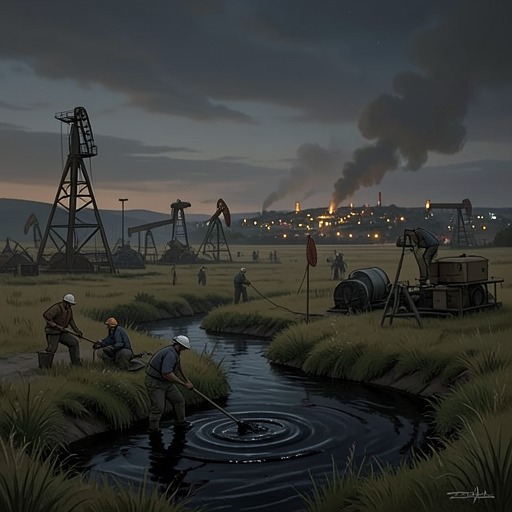
Burbank field
Killers of the Flower MoonBurbank field was a major oil-producing area in the Osage reservation, where a single new well could yield hundreds of barrels in a day and a lease could command more than a million dollars. Its history shows how the Osage mineral-rights agreement turned land beneath the surface into extraordinary wealth—and how that wealth was administered, auctioned, and exposed to exploitation.
Mineral Rights and the Land Below
The field’s significance rested on the Osage’s success in retaining the reservation’s mineral rights during allotment negotiations. In the 1906 agreement, the tribe secured the reservation of oil, gas, coal, and other minerals to the Osage Tribe. Although the tribe knew of oil deposits, few anticipated the scale of the fortune beneath its land. The resulting arrangement left the surface open to allotment while keeping mineral wealth under collective Osage ownership.
That distinction shaped the field’s later history. Oil companies could compete to drill through leases, while the Osage retained the mineral interest that generated revenue. Burbank’s emergence as a rich field made the reserved subsurface a valuable asset and a focus of escalating bids.
Discovery and Production
In 1920, E. W. Marland discovered Burbank, described as one of the highest-producing oil fields in the United States. A new well there generated 680 barrels during its first twenty-four hours. The figure gives a concrete measure of the field’s productivity and helps explain why oil development in Osage territory drew growing attention from producers and investors.
The boom’s effects were visible across the reservation. Oil discoveries could erupt into spectacular gushers, and the Osage gathered to watch the streams rise above the rigs. Those scenes belong to the wider oil boom rather than to a specifically identified Burbank well, but they convey the scale and public presence of the industry that made fields such as Burbank so consequential.
Leases and the Million-Dollar Market
The Department of the Interior oversaw Osage oil-lease auctions, held about four times a year. Since the auctions began in 1912, only part of the reservation’s vast underground mineral territory had been opened to drilling; a typical lease covered a 160-acre tract. Competition drove lease prices sharply upward, turning mineral access into a high-stakes market.
At one auction, Tract 14—situated in the middle of the rich Burbank field—became the focus of a bidding contest. A representative of Gypsy Oil Company opened with a bid of half a million dollars. The tract ultimately sold for $1.1 million. Across the auctions, prices and totals continued to rise: one lease sold for nearly $2 million, while the highest total collected at an auction approached $14 million. Burbank thus appears not only as a productive place but as terrain whose value was measured publicly, tract by tract, in increasingly extraordinary sums.
Wealth, Extraction, and Decline
The revenue produced by Osage oil did not translate into uncomplicated security. The wider system of guardianship and estate administration enabled some white guardians to inflate prices, direct business for kickbacks, acquire property for themselves, or steal from Osage wards. A government study estimated that guardians had taken at least $8 million directly from restricted Osage accounts before 1925. These abuses were part of the financial structure surrounding oil wealth, not evidence that a particular Burbank lease or payment was stolen.
The boom also proved vulnerable to falling prices and depletion. During the Great Depression, the price of oil fell from more than three dollars a barrel during the boom years to sixty-five cents in 1931, and an annual headright payment fell below $800. The book describes gradual depletion across the oil fields and the decline of boomtowns, but does not give a separate later production or depletion figure for Burbank itself. The field’s importance therefore lies both in its striking early productivity and in the broader history of a mineral fortune whose value depended on extraction, market prices, and control over the income it generated.